The eternal thing is God

Your Ad Here

Sunday, April 4, 2010

Dasavatar


1. Matsya, the fish, appeared in the Satya Yuga.The Fish Incarnation is the first incarnation of Vishnu. Lord Vishnu takes the form of a fish in order to retrieve the Vedas from the demon Hayagriva, who stole them from Lord Brahma. Without the Vedas, Creation of the Universe cannot take place. He slayed the demon Hayagriva, recovered the Vedas, and also saved the pious king Satyavrata from the deluge so that life and religion can be preserved for the next cycle of Creation.
2. Kurma, the tortoise, appeared in the Satya Yuga. The turtle Incarnation is the second incarnation of Vishnu. When the devas and asuras were churning the ocean in order to get the nectar of immortality, the mount Mandara they were using as the churning staff started to sink and Lord Vishnu took the form of a turtle to bear the weight of the mountain.
3. Varaha, the boar, appeared in the Satya Yuga. The Boar incarnation is the third incarnation of Vishnu. He appeared in order to defeat Hiranyaksha, a demon who had taken the Earth (Prithvi) and carried it to the bottom of what is described as the cosmic ocean in the story. The battle between Varaha and Hiranyaksha is believed to have lasted for a thousand years, which the former finally won. Varaha carried the Earth out of the ocean between his tusks and restored it to its place in the universe.
4. Narasimha, the half-man/half-lion appeared in the Satya Yuga. The Man-Lion Incarnation is the fourth incarnation of Vishnu. When the demon Hiranyakashipu acquired a boon from Brahma, which gave him inordinate power, Lord Vishnu appeared in the form of half-man/half-lion, having a human-like torso and a lower body, but with a lion-like face and claws. Hiranyakashipu could not be killed by human, deva or animal, Narasimha is neither one of these, as he is a form of Vishnu incarnate as a part-human, part animal. He comes upon Hiranyakashipu at twilight (when it is neither day nor night) on the threshold of a courtyard (neither indoors nor out), and puts the demon on his thighs (neither earth nor space). Using his sharp nails (neither animate nor inanimate) as weapons, he disembowels and kills the demon.
5. Vamana, the dwarf, appeared in the Treta Yuga. The fourth lineal descendant of Hiranyakashyap, named Bali, through his devotion and penance defeated Indra, the god of firmament, humbled other gods and extended his authority over the three worlds. All the gods appealed to Lord Vishnu for protection and He became manifest in His Dwarf Avatar of Vaman for the purpose of restraining Bali. Once when this king was making a great religious offering, Lord Vishnu in the form of Vaman appeared before him in the company of other Brahmins. Bali was extremely pleased to see a holy man with such a diminutive form and promised to give him whatever he should ask. Lord Vishnu asked only for as much land as he could measure by three steps. Bali laughingly agreed to grant the boon of three steps. Lord Vishnu as dwarf stepped over heaven in first stride and earth in the second stride. Then out of respect to Bali's kindness and his grandfather Prahlad's great virtues, Lord Vishnu stopped short and left him in pathal, the subterranean region. Bali is believed to have ruled Kerala.
6. Parashurama, Rama with the axe, appeared in the Treta Yuga. Parashurama a Brahmin, the sixth avatar of Vishnu, belongs to the Treta yuga, and is the son of Jamadagni and Renuka. Parashu means axe, hence his name literally means Rama-of-the-axe. He received an axe after undertaking a terrible penance to please Shiva, from whom he learned the methods of warfare and other skills. Parashurama is said to be a "Brahma-Kshatriya" (with the duties between a Brahmana and a Kshatriya), the first warrior saint. His mother is descended from the Kshatriya Suryavanshi clan that ruled Ayodhya and Lord Rama also belonged to. A haihaya King Kartavirya Arjuna (Sahasrarjuna - purportedly with a thousand arms) and his army visited Jamadagni, a Brahmin sage, who fed his guest and the whole army with his divine cow Kamadhenu. The king demanded the magical cow. Jamadagni refused because he needed the cow for his religious ceremonies. King Kartavirya Arjuna (Sahasrarjuna) took the cow forcibly and devastated the ashram. Angered at this, Parashurama killed the king's entire army and, after cutting each one of his thousand arms, the king himself with his axe. As a revenge, the King's sons killed Jamadagni in Parashurama's absence. Furious at his father's murder, Parashurama killed all sons of Sahasrajuna and their aides. His thirst for revenge unquenched, he went on killing every adult Kshatriya on earth, not once but 21 times, filling five ponds with blood. These are the actions which highlight his warrior characteristics. Ultimately, his grandfather, Richeek Rishi, appeared and stopped him.
7. Rama, Ramachandra, the prince and king of Ayodhya, appeared in the Treta Yuga. Lord Rama is one of the most commonly adored gods in Hinduism and is known as an ideal man and hero of the epic Ramayana. Lord Rama defeated and killed the king of Sri Lanka, Ravana for capturing and imprisoning his wife Sita in the Ashoka Garden in Sri Lanka.
8. Krishna (meaning 'dark coloured' or 'all attractive') appeared in the Dwapara Yuga along with his brother Balarama. According to the Bhagavata Purana Balarama is said to have appeared in the Dwapara Yuga (along with Krishna) as an incarnation of Ananta Shesha. He is also counted as an avatar of Vishnu by the majority of Vaishnava movements and is included as the ninth Dasavatara in some versions of the list which contain no reference to Buddha. Because of his great Godly power, Lord Krishna is another of the most commonly worshipped deities in the Hindu faith. He is considered to be the eighth avatar of Lord Vishnu. He played a huge role in the Battle of Kurukshetra and helped the Pandavas defeat the Kauravas. He is also a significant character in the epic of Mahabharata. Shree Krishna delivered Bhagwad Gita on battlefield of the Battle of Kurukshetra to Arjun. He, like Lord Rama, is also known for his bravery in destroying evil powers throughout his life. The Lord is usually depicted as playing the flute (murali), indicating spread of the melody of love to people.
9. Buddha (See alternative lists below for Balarama at this position) See also: Buddha as an Avatar of Vishnu. With the departure of Lord Krishna (Krishna Avatar), the age of Kali set in, in this age, the true devotion to Vedas was replaced by empty rituals. To enlighten the world in such times, Lord Vishnu descended the earth as Buddha, the enlightened one.
10. Kalki ("Eternity", or "time", or "The Destroyer of foulness"), who is expected to appear at the end of Kali Yuga, the time period in which we currently live. The tenth and the last avatar of Vishnu, Kalki, is yet to appear. Kalki will appear at the end of the Kalyuga. This avatar will appear seated on a white horse with a drawn sword blazing like a comet. He shall come finally to destroy the wicked, to restart the new creation and to restore the purity of conduct in people's lives.

Similarity between Darwinism and Dasavatara

Life originated in water in unicellular form to start with. This was followed by aquatic life forms, and subsequently Amphibians(i.e. creatures who could live equally well in water as well as on land) came into existence. Homo Sapiens evolved during a very later stage of evolution. Scientists have postulated various theories about this evolution. Darwin, Wallace & others postulated various theories on this subject.

British geneticist and evolutionary biologist, J B S Haldane, observed that the Dasavataras are a true sequential depiction of the great unfolding of evolution.[citation needed]. The first few avatars of Vishnu show an uncanny similarity to the biological theory of evolution of life on earth.[8]
Avatars Explanation Evolution

Matsya

First avatar is a fish, one which is creature living in water. If we compare it with biological evolution on different Geological Time Scale first developed life was also in the form of fish which originated during Cambrian period.

Kurma

Second avatar was in the form of Tortoise (reptiles). In geology also first reptiles comes as second important evolution which originated in Mississippian period just after Amphibians.

Varaha

Third avatar was in the form of Boar. Evolution of the amphibean to the land animal.

Narasimha

The Man-Lion (Nara= man, simha=lion) was the fourth avatar. But in geology no such evidences are mentioned. It may have been related with Ape Man The term may sometimes refer to extinct early human ancestors, such as the undiscovered missing link between apes and humans.

Vamana

Fifth Avatar is the dwarf man. It may be related with the first man originated during Pliocene.

Parashurama

The man with an axe was the sixth avatar. It has the similarities with the first modern man originated during Quaternary period or the man of Iron Age.

Lord Rama, Lord Krishna and Lord Buddha were the seventh, eighth and ninth other avatars of Lord Vishnu. It indicates the physical and mental changes and evolution in the man from its time of appearance.

Monday, October 12, 2009

Bhagawad Gita

The Bhagavad- Gita is considered by eastern and western scholars alike to be among the greatest spiritual books the world has ever known. In a very clear and wonderful way the Supreme Lord Krishna describes the science of self-realization and the exact process by which a human being can establish their eternal relationship with God. In terms of pure, spiritual knowledge the Bhagavad- Gita is incomparable.


Its intrinsic beauty is that its knowledge applies to all human beings and does not postulate any sectarian idealogy or secular view. It is appproachable from the sanctified realms of all religions and is glorified as the epitome of all spiritual teachings. This is because proficiency in the Bhagavad- Gita reveals the eternal principles which are fundamental and essential for spiritual life from all perspectives and allows one to perfectly understand the esoteric truths hidden within all religious scriptures. Many great thinkers from our times such as Albert Einstein, Mahatma Gandhi and Albert Schweizer as well as Madhvacarya, Sankara and Ramanuja from bygone ages have all contemplated and deliberarted upon its timeless message. The primary purpose of the Bhagavad- Gita is to illuminate for all of humanity the realization of the true nature of divinity; for the highest spiritual conception and the greatest material perfection is to attain love.


Bhagawat Gita is divided into 18 Chapters. They are:


  1. Visada Yoga

  2. Sankhya yoga

  3. Karma yoga

  4. Jnana yoga

  5. Karma Vairagya yoga

  6. Abhyasa yoga

  7. Paramahamsa Vijanana yoga

  8. Aksara Parabramaham yoga

  9. Raja Vidya Guhya yoga

  10. Vibuti Vistara yoga

  11. Viswaroopa Darsana yoga

  12. Bhakthi yoga

  13. Ksetra Ksetrajna Vibhaga yoga

  14. Gunatraya Vibhaga yoga

  15. Purushottama yoga

  16. Daivasura Sampad Vibhag yoga

  17. Sraddhatraya Vibhaga yoga

  18. Moksha Upadesa yoga

Tuesday, August 25, 2009

Shiva Puran

SHIV MAHAPURAN


INTRODUCTION

Sage Shaunak expressed his desire to Sutji about knowing the means, which could help a man in this era of Kali to attain lord Shiva, by cleansing all the impurities of his mind and rectifying his inherent demonic tendencies. Sutji then described Shiv Mahapuran - the supreme of all the puranas, which was narrated by Lord Shiva himself and which was later retold by Sage Vyas with the permission of Maharshi Sanatkumar, for the benediction of common man. Sutji said, "By understanding the mysteries of Shivmahapuran and singing its praises, a man attains greater virtues than that which could be attained by being charitable or by the performance of all the `yagyas'. Contemplating on the subject matters of Shivmahapuran give auspicious fruits just like a 'Kalpa-taru' (A mythological tree which fulfills all the wishes). Shiv Mahapuran contains twenty-four thousand shlokas and seven samhitas which are:

  1. VIDYESHWAR SAMHITA

  2. RUDRA SAMHITA

  3. SHATRUDRA SAMHITA

  4. KOTI RUDRA SAMHITA

  5. UMA SAMHITA

  6. KAILASH SAMHITA

  7. VAYVIYA SAMHITA


Shivmahapuran is the best means for man's liberation.

PROPER METHOD OF LISTENING TO SHIVPURAN

Sage Shaunak requested Sutji to tell about the proper method of listening to Shivpuran, so that the man kind gets complete benefit. Sutji replied-
"First, an auspicious moment should be determined by an Astrologer. After that, friends and relatives should be invited, especially those who have the tendency of being away from such occasions. The sages and the virtuous people should be invited too. The 'Katha' must be help in scared places like Shiva temple, any place of pilgrimage or in one's home after doing a Bhumi Pujan of the land Where one intends to held the Katha of Shiv Puran. The canopy should be well decorated." "After making a resolution and doing worship of Ganapati - the destroyer of all hurdles and obstacles the Katha should be commenced. The person who is telling the 'Katha' should be facing north and all the listeners should sit facing east. The person who is telling the 'Katha' should be a scholar and should be capable of clearing all the doubts from the listener's mind. There should be no kind of distraction during the 'Katha' period. A devotee, who listens to the Katha leaving behind all of his worldlys worries get complete benefits. A devotee should also make donations and offerings according to his capacity and capability otherwise he would become a wretched man. The Mantra ' NAMAH SHIVAY' should be chanted through out the period of Katha.

RIGHT OF LISTENING TO SHIVMAHAPURAN:-

An uninitiated person does not have the right to listen to the Katha of Shivmahapuran. So a man desirous of listening to Shivmahapuran should first get initiated.

AUSTERITIES TO BE FOLLOWED:

A devotee who has taken the vow of listening to the Katha of Shivmahapuran, should follow a celibate life. He should sleep on the floor and should have only fruits in the diet. He can have his normal dinner only after the completion of the Katha. The diet should be fresh and pure. He should also try to avoid sinful tendencies like lust, anger, greed, attachment and condemning other, etc. Making donations of even meager things give undiminishing virtues.

RITES PERFORMED ON COMPLETION OF OBSERVANCE:-

After the methodical completion of the Katha, a devotee should perform UDDYAPAN (Conclusion of the Katha), which is similar to the CHATURDASHI UDDYAPAN. The devotee should also Charitably make donations to all the brahmins who have helped in the performance of Katha. On the next day the 'Path' of SHIV GITA should be performed. If the devotee (listener of the Katha) is a householders, then he should perform 'Havan' with the ghee prepared from Cow's milk, for the pacification of the unhindered completion of the Katha. The Havan should be performed, either with the help of 'Rudra Samhita mantras' or 'Gayatri Mantra' or with the shlokas of Puran.

To read the samhithas please click on the respective Samhitaas


  1. VIDYESHWAR SAMHITA

  2. RUDRA SAMHITA

  3. SHATRUDRA SAMHITA

  4. KOTI RUDRA SAMHITA

  5. UMA SAMHITA

  6. KAILASH SAMHITA

  7. VAYVIYA SAMHITA

Check it out


Wednesday, March 19, 2008

Islam

Islam (Arabic: الإسلام; al-'islām (help·info)) is a monotheistic Abrahamic religion originating with the teachings of Muhammad, a 7th century Arab religious and political figure. The word Islam means "submission", or the total surrender of oneself to God (Arabic: الله, Allāh).[1] An adherent of Islam is known as a Muslim, meaning "one who submits (to God)".[2][3] There are between 1.1 billion and 1.8 billion Muslims, making Islam the second-largest religion in the world, after Christianity

What did Jesus Do-Is not the question u ask...

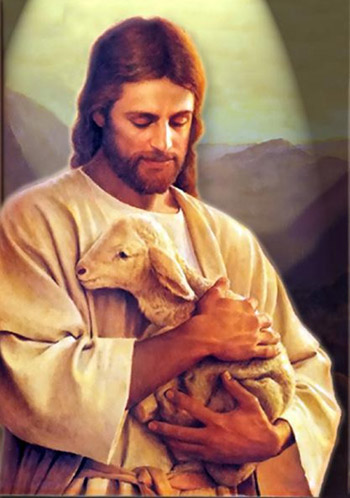
When considering how to live our lives, we often ask, "What would Jesus do" but perhaps we should be asking, "What did Jesus do." I would like to focus on several characteristics of the life of Jesus Christ - characteristics we can strive for in our own lives. Click here to know more"Jesus"

Ramayan

The Rāmayaṇa (Devanāgarī) रामायण is an ancient Sanskrit epic attributed to the poet Valmiki and an important part of the Hindu canon sm

Ramayan

The Ramayan (Devanāgarī: रामायण) is an ancient Sanskrit epic attributed to the poet Valmiki and an important part of the Hindu canon (smṛti).

Monday, March 17, 2008

Mahabharath


Part 1Story of Shakuntala Part 2Story of Shibi Rana Part 3 Story of King Shantanu
Part 4 Story of Bhishma Part 5 Story of Arjuna Part 6 Story of Eklavya
Part 7 Story of Karna 2 Part 8 Jealous Duryodhana Part 9 Marriage of Bhima
Part 10 Marriage With Draupadi Part 11 The Indraprastha Kingdom Part 12 The Game Of Dice
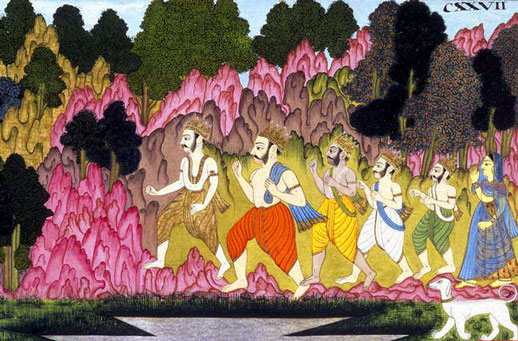
Part 13 Second Game Of Dice! Part 14 Pandavas Exiled to Forest Part 15 Life in Forest 2
Part 16 Life in Exile 3 Part 17 Story of Yudhisthira Part 18 Life In Exile 4
Part 19 The Last Year In Exile Part 20 Preparation For War? Part 21 War Of Kurukshetra
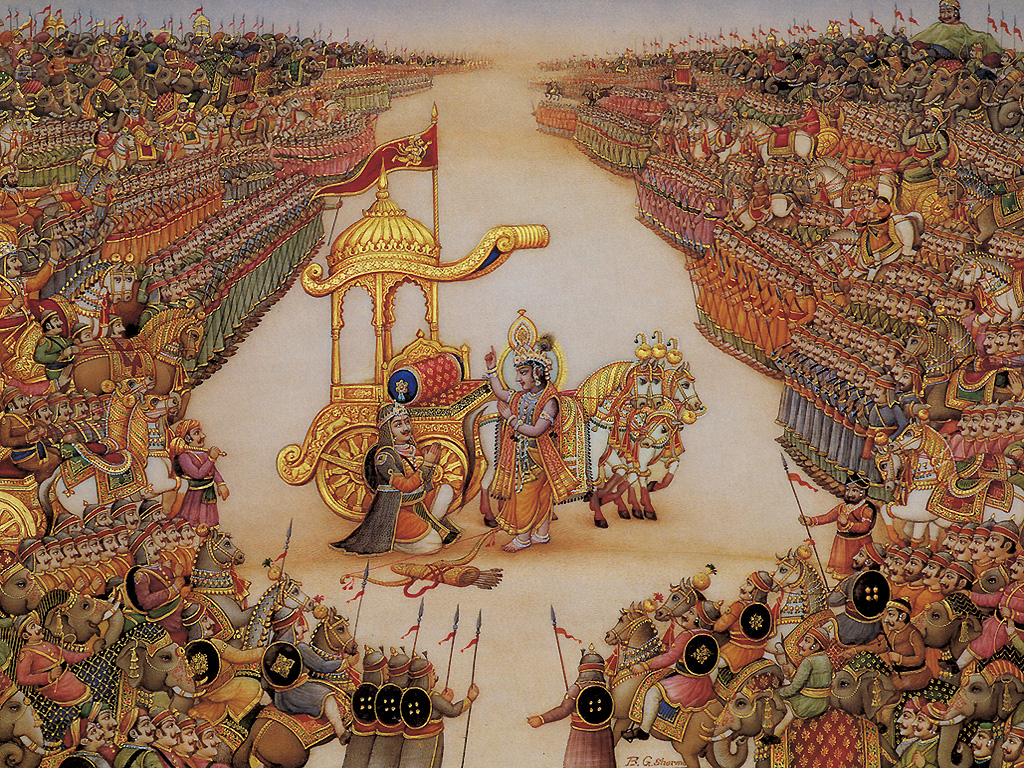
Part 22 Sri Krishna Tells The Gita Part 23 The War Continues Part 24 Yudhisthira Tells a Lie!
Part 25 End of War


Introduction

The two great epic works of the Hindus are Ramayan and Mahabharat. In modern terms the Mahabharat may be said to be realistic and the Ramayan idealistic, in their respective handling of human characters.

Sita in Ramayan is all that a woman could or should be. And is impressive by her sweetness and devotion. Draupadi in Mahabharat, on the other hand maybe any of the high spirited modern women with her anger and brooding for revenge and for that reason more human.

There is greater realistic truth in the full blooded characters of Mahabharat, higher passion, nobler resolve, fierce jealousy and more biting scorn and greater grandeur in many of it's scenes. Yet it is greater spiritual beauty, greater softness and tenderness of emotions in Ramayan. The subject of Mahabharat is men and war, while the subject of Ramayan is women and home.

These epics are regarded as the Vedas of the masses. People in sorrow, in joy and in daily toil turn to these epics for solace and inspiration. In Indian context norms of Epic are set by Ramayan and Mahabharat.

Many more topics were treated in great length by number of line verses or chapters but none equals these two. Interestingly, these two epics have provided canvas or theme for many forms of art, like paintings, sculpture, poems, plays and stories. This epic is written by Krishnadvaipayan Vyas. It was claimed that whatever that can exist in human life is all dealt with by Vyas in Mahabharat and conversely. Whatever that does not exist in Mahabharat can not exist in the world.

It is a story of a dynasty of Kuru that is Kaurav. Later on lineage assigned to Pandu that is dynasty of Pandava.And finally war between the two related families,which involved many small kingdoms throughout the nation.The final version of the epic was formed in the fourth century A.D.There are many Parvas having lacks of Shlokas. The most authentic version of Mahabharat was prepared in 20th century by many researchers under the guidance of Mr. Vaidya in Bhandarkar Oriental Research Institute.

The story of Mahabharat has many substories, many plots and subplots hence by spread it is very wide. The epic has also inspired many artists like that by Ramayan. Many plays such as Abhidnyan Shakuntala, by Kallidasa, plays by Bhasa such as Venisamhara, Urubhanga etc. are based on the themes or plots from Mahabharat.The story is believed to have taken place around 1500 years BC.

Interestingly it was mentioned as history while the Ramayan was mentioned as a part of Purana. It was originally written as 'Jay'. It was later on revised as 'Bharata' and it was further expanded as 'Mahabharat'. It consists of story of Dushyant a king and Shakuntala a daughter of heavenly dancer Menaka. Her son was named as Bharat. He later on ascended the throne of Dushyant.

The name of the nation designated by foreigners as India bears his name to the subcontinent as Bharat. Hence the name of the nation is Bharat alias India. If Ramayan is symbolised as ideality and for setting up the norms and standards of ideality, Mahabharat can be considered as depiction of reality.

Ramayan has taught what it should be, whereas Mahabharat has bravely depicted what it generally is. It is story of lust, and renunciation, pious as well as crooks. It speaks of fearless warriors and cowardly behavior of some of them. Of obedience as well as rebels.

Though it is mainly a story of dynasties a character coming as a shepherd brought up as foster son of a chief in a village Mathura is raised to the height of God in the Indian minds. He is the one who is responsible for the final war between the two kingdoms to assert for righteous claim and only he is credited with the out come of the war, the victory of Pandavs.

Mahabharat as a pool of information mirrors society at that time, customs rites and rituals, value system and ethics of the time. It also speaks of political variation in the form of local democratic government to rural form of governance to kings and kingdom. It also reflects racial as well as cultural struggles amongst the different people of India. It has forged the Indian identity as unity in variety of races, languages, religious beliefs etc.